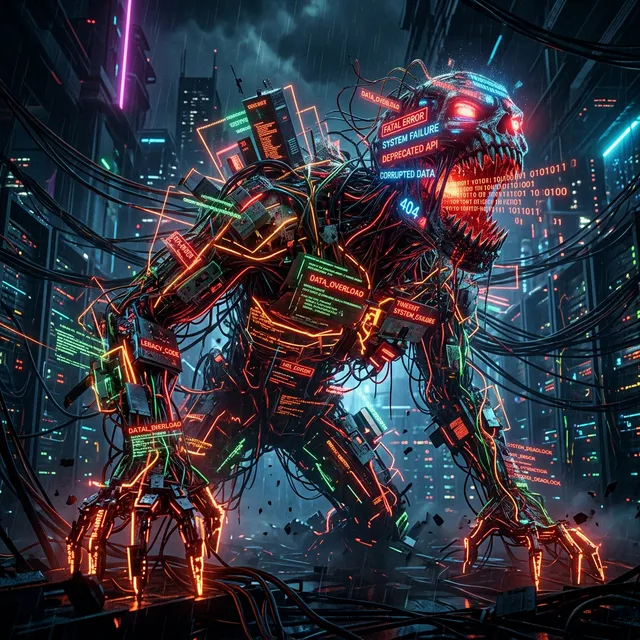
In my last post, we examined the Citrini scenario, where the mere threat of AI-generated software is enough to crush enterprise SaaS margins and trigger a macroeconomic crisis. But today, I want to step out of the boardroom and look at the actual codebase. Is it really that simple? Can an enterprise simply “vibe code” a sprawling architecture into existence and fire the engineering team without catastrophic consequences?
If you have read my previous thoughts on Zombie Diagrams - those static architecture diagrams that are effectively dead the moment they are drawn - you already know where this is going. AI-generated enterprise software, built rapidly and without rigorous structural foundations, is destined to become the ultimate Zombie Architecture.
The Reality of Edge Cases
The engineers and analysts pushing back against the AI doomsday scenario agree on one fundamental truth: writing a script is not the same as building a system. An insider working in a Big Tech Cloud and AI division recently pointed out that current AI software engineering capabilities are “nowhere near the current hype”.
While a CEO might be dazzled by a demo that spins up a functional UI in seconds, replacing an established SaaS vendor with an AI-generated, in-house solution based on a few successful prompts would likely be a “devastatingly bad decision” for a company. Even Citrini’s own aggressively bearish scenario admits that these AI-generated replicas are built “not perfectly or with every edge case handled”.
As anyone who has spent time building high-stakes trading systems knows, the edge cases are the enterprise. When an un-architected, “good enough” AI prototype hits production, the hidden costs of maintenance, tech debt, and system sprawl will explode exponentially.
Zero-Friction Means Zero-Trust
Beyond the fragility of the code itself, we have to consider the environment these systems will operate in. Analyst Zvi Mowshowitz highlights a terrifying reality of a world run by zero-marginal-cost AI agents: the ecosystem will be “absolutely overflowing with outright frauds and scams”.
If everyone is instantly generating bespoke, unvetted software to handle their business logic, positive-sum arrangements break down. Why? Because anything that can be abused, will be. If interception attacks, system gaming, and continuous automated probing become virtually free, the threat surface of a company relying on undocumented, “vibe-coded” microservices will be unfathomable. We are already seeing the market anticipate this chaotic tech sprawl, with investors actively questioning whether the looming “Software Meltdown” means it is time to pivot heavily into cybersecurity.
The Accountability Wall
There is also the inescapable reality of human accountability. The utopian vision assumes that all white-collar intermediation can be replaced by agents. However, AI is not going to fully replace high-stakes sectors like legal, healthcare, or financial services. Whether it is anesthesiology, a complex legal defense, or a split-second, life-altering financial decision, when a critical system fails, human accountability will always be demanded.
Why Architecture Matters More Than Ever
This looming mess is exactly why I have been advocating so heavily for Architecture as Code and initiatives like CALM (Common Architecture Language Model). LLMs need structured data to be effective. If we are entering an era where AI generates vast amounts of business logic, keeping our system documentation integrated with development workflows is no longer a luxury - it is a survival mechanism.
Generating code has become cheap. But orchestrating a secure, compliant, and maintainable enterprise requires actual architecture. The utopian vision of frictionless, AI-generated enterprise software completely ignores the massive, hidden costs of maintenance, security, and integration that inevitably arise when fragile prototypes are forced into production.